

Executive Summary
Ongoing due diligence backlogs are a persistent operational and regulatory challenge for financial institutions managing large client portfolios. When case volumes accumulate faster than compliance teams can process them, institutions face both regulatory exposure and a structural inability to scale their way out of the problem through headcount alone. This case study examines how spektrQ supported a client in remediating a backlog of outstanding due diligence cases by deploying automated screening and case management workflows that covered the full scope of remediation activity – including screening, UBO changes, and associated documentation requirements.
Problem Statement
Ongoing due diligence obligations require financial institutions to periodically review and refresh the compliance records of their existing client base. In practice, the accumulation of these reviews into a backlog is common. Trigger events – changes in risk classification, regulatory updates, periodic review cycles – generate case volumes that frequently exceed the processing capacity of compliance teams operating under manual workflows.
The consequences of an unmanaged backlog extend beyond operational inefficiency. Outstanding due diligence cases represent a documented gap between the institution's stated compliance obligations and its actual state of compliance. For regulated institutions, this gap carries direct regulatory risk. For compliance teams, it creates a compounding dynamic: new cases continue to be generated while existing ones remain unresolved, and the backlog grows faster than it can be addressed through conventional means.
The nature of ODD remediation adds further complexity. Each case may involve multiple components – screening against sanctions and PEP databases, verification of UBO changes, review and update of associated documentation – and the appropriate course of action varies depending on the client's risk profile and the specific trigger that initiated the review. This variability makes the process resistant to simple rule-based automation, while the volume makes it unsuitable for purely manual treatment.

Solution
spektrQ deployed a modular automated workflow to manage the full remediation cycle for outstanding ODD cases. The workflow was configured to address the specific components of each case type – screening, UBO change processing, and documentation review – within a single, auditable process.
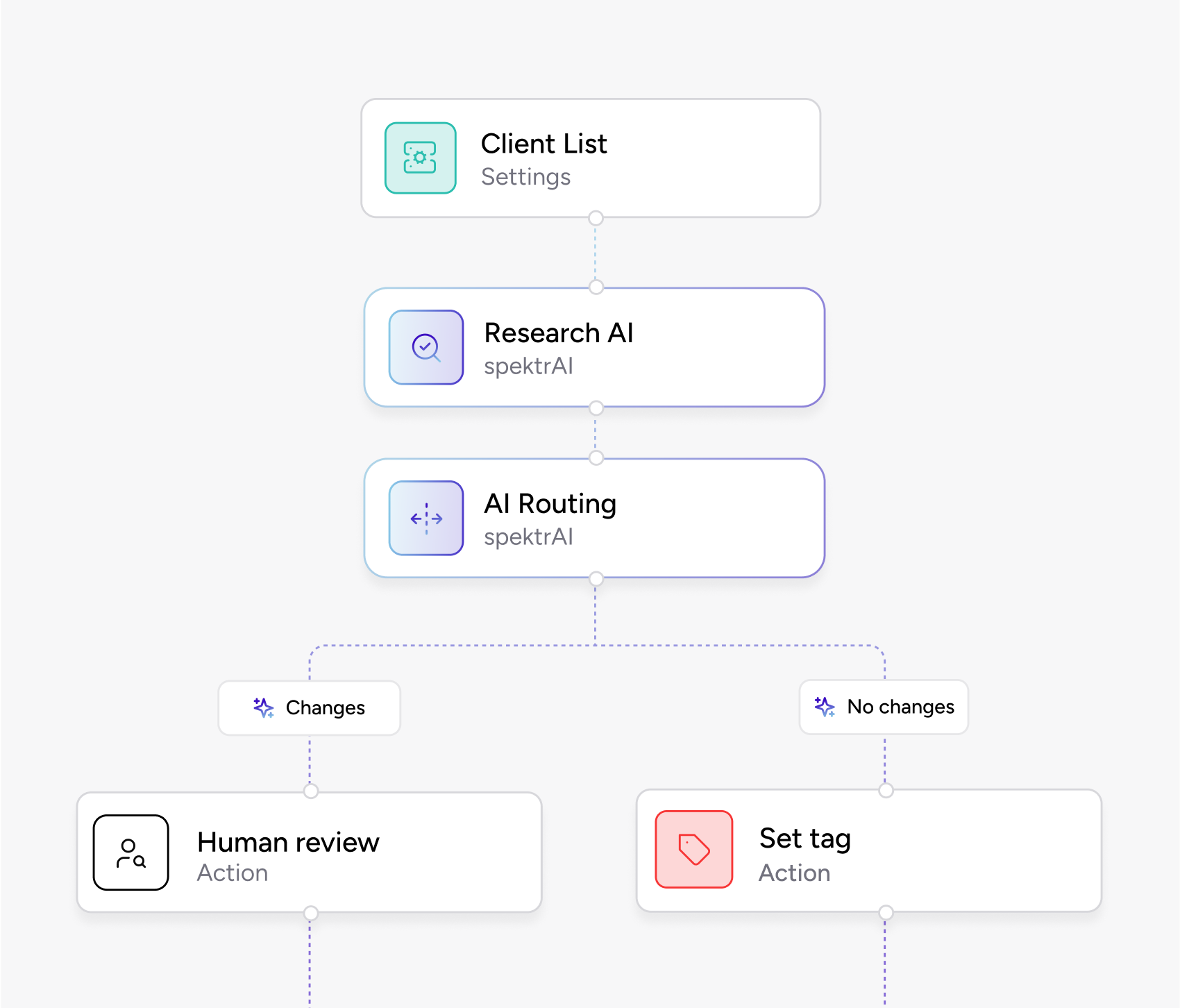
For screening components, the workflow automated the submission of screening requests, the retrieval of results, and the initial assessment of alerts against the institution's defined risk parameters. Cases where screening results were clean and no other remediation triggers were present were closed automatically, with full documentation retained in the system of record. Cases requiring further review were escalated to analysts with a structured summary of the relevant findings.
For UBO change components, the workflow identified and processed updates to beneficial ownership records, flagging cases where changes exceeded defined materiality thresholds for analyst review. Documentation requirements associated with each case type were mapped to the workflow logic, enabling the system to identify missing or expired documents and initiate the appropriate collection process.
Technical Approach
The remediation workflow was built using spektr's modular workflow builder, which enabled the compliance team to configure and iterate on case logic without dependency on internal engineering resources. The workflow was designed to process cases in parallel rather than sequentially, enabling the institution to address the full backlog simultaneously.
Cases where screening results were clean and no remediation triggers were present were closed automatically; cases requiring further review were escalated to analysts with a structured summary of the relevant findings. All workflow outputs were logged with full audit trails, enabling the institution to demonstrate to regulators the systematic and documented nature of the remediation process.

Outcomes
The deployment enabled the institution to address its ODD backlog at a scale and pace that would not have been achievable through manual processing. The proportion of cases requiring direct analyst involvement was reduced to those where the workflow identified a genuine risk trigger or a documentation gap requiring human judgment. The remainder were resolved systematically, with full documentation, within the automated workflow.
The compounding dynamic that characterises manual backlog management – where new cases accumulate faster than existing ones are resolved – was broken. The institution achieved a state of current compliance across its portfolio and established the automated workflow as its ongoing mechanism for managing future remediation requirements.
Conclusion
ODD backlog remediation is a problem that is both operationally significant and structurally difficult to address through conventional means. The variability of case types and the volume of cases involved make it unsuitable for either purely manual treatment or simple rule-based automation. A modular AI-driven workflow, configured to the institution's specific case types and risk parameters, offers a path to resolving the backlog systematically while maintaining the audit quality and regulatory defensibility that compliance obligations demand.