.gif)


Executive Summary
The manual review of compliance-relevant documents – annual reports, identity verification files, source of wealth documentation, and bank statements – represents a significant and largely routine demand on compliance analyst capacity. This case study examines how spektrQ deployed a document AI agent to automate the retrieval, processing, and structured review of compliance documents across a client portfolio, enabling the institution to redirect analyst capacity toward higher-order judgment tasks while maintaining full audit quality and regulatory defensibility.
Problem Statement
Compliance functions across regulated industries are required to collect, review, and retain a defined set of documents for each client relationship. The nature of these documents varies by client type and risk profile – identity verification, address confirmation, source of wealth, annual reports, and beneficial ownership records are among the most common – but the review process follows a consistent pattern: a document is received or retrieved, assessed against a defined checklist of criteria, and either accepted, flagged for further review, or rejected.
In the manual model, this process is performed by analysts on a document-by-document basis. For large portfolios, the aggregate volume of document reviews is substantial. Annual reports alone, published on an unpredictable schedule across the calendar year, can generate surges in review volume that compliance teams are structurally ill-equipped to absorb. When multiple client relationships file reports within the same period, the result is a backlog of pending reviews that accumulates faster than it can be processed.
The inefficiency is compounded by the nature of most document reviews. The majority of annual report reviews, for example, conclude with no action required – ownership has not changed, the primary business activity is unchanged, financial reserves are within expected parameters. The analyst's time spent reaching this conclusion is time that cannot be directed toward cases where material changes have occurred and where human judgment adds genuine value. The absence of intelligent triage means that routine and complex reviews are processed through the same manual workflow.

Solution
spektrQ deployed a document AI agent configured to monitor for, retrieve, and assess compliance-relevant documents automatically. The agent was initially deployed for annual report monitoring, with the document processing framework designed to be extensible to other document types – including identity verification, address confirmation, and source of wealth documentation – as the institution's requirements evolved.
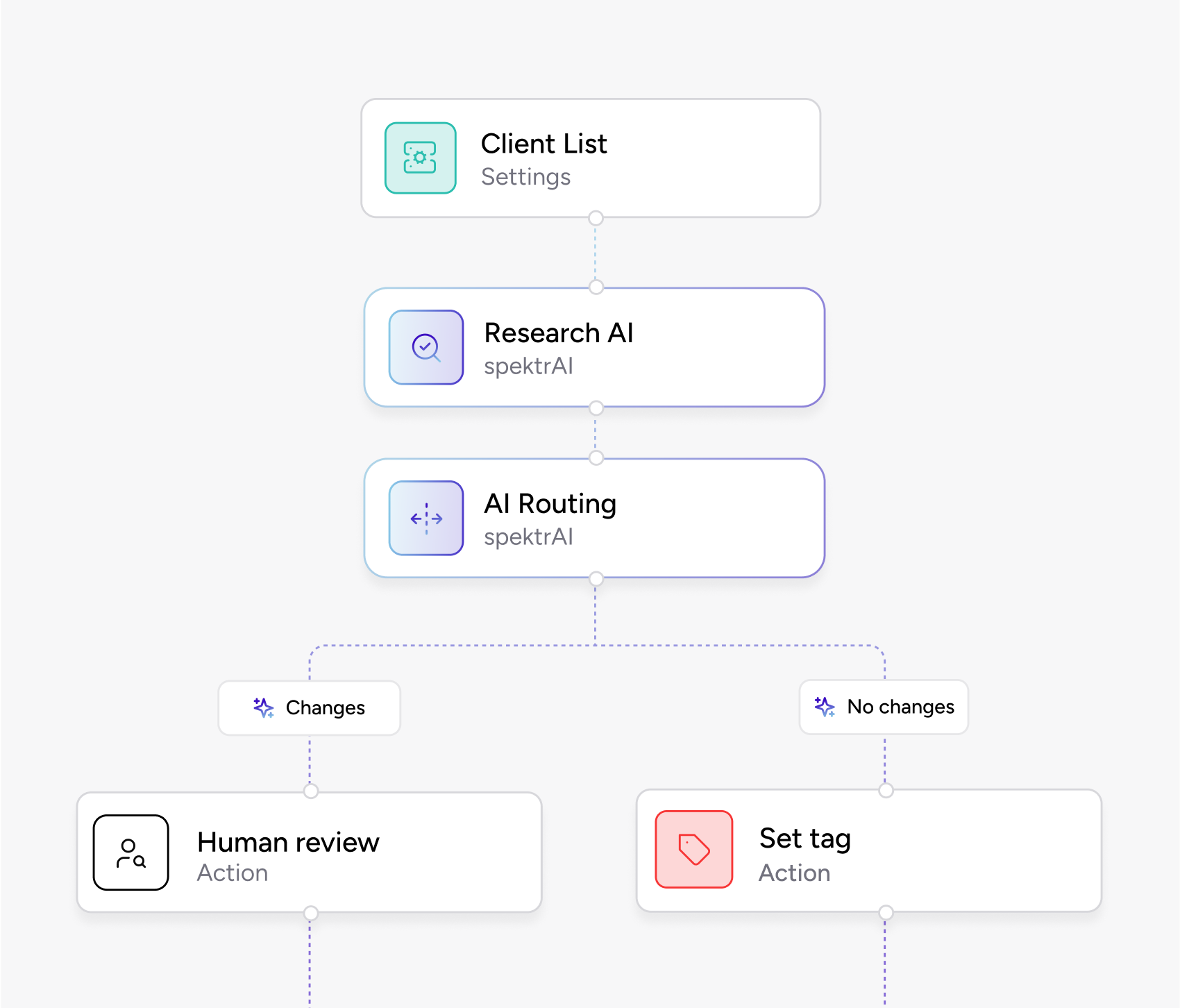
For annual report monitoring, the agent was configured to monitor the relevant public company register for new filings across the institution's full client portfolio. When a report was published, the agent automatically retrieved it and initiated a structured review against a predefined compliance checklist. The checklist assessed a defined set of risk-relevant criteria: changes in ownership structure, shifts in primary business activity, changes in operational scale, and material movements in financial reserves.
Where none of the defined criteria were triggered, the agent produced a documented assessment, filed the case, and closed the review without analyst involvement. The full audit trail – including the document retrieved, the criteria assessed, and the outcome recorded – was retained in the system of record. Where one or more criteria were triggered, the case was escalated to an analyst with a structured summary of the findings and the relevant source passages from the document, enabling the analyst to focus directly on the material issue rather than reviewing the full document from scratch.
For other document types, the agent was configured with templates defining the expected document format and the specific data points to be extracted and verified. A utility bill submitted for address verification, for example, would be assessed against criteria including the issuing utility provider, the document date, and the address details – with the agent's output indicating whether the document met the institution's defined requirements or required further review.
Technical Approach
The document processing layer applies optical character recognition and structured data extraction to identify and classify the relevant sections of each document. The checklist logic is defined as a configurable set of conditional rules within spektr's modular workflow builder, enabling the compliance team to adjust assessment criteria and risk thresholds as regulatory requirements or internal policy evolves – without dependency on internal engineering resources.
The agent operates continuously, processing documents as they are received or published rather than in batched review cycles. This eliminates the surge dynamic that characterises manual review workflows, as volume peaks are absorbed in real time rather than accumulating into a backlog. All outputs are logged with timestamps, confidence indicators, and source references, providing a complete and auditable record of each assessment.

Outcomes
The deployment produced a material reduction in the volume of document reviews requiring direct analyst involvement. Reviews in which no risk criteria were triggered – the majority of cases across a well-managed portfolio – were processed entirely by the agent, with analysts receiving only a confirmation of closure and the associated documentation. Analyst time was redirected to cases where the agent identified a material trigger and where human judgment was required to determine the appropriate course of action.
The unpredictable surge dynamic that previously characterised high-volume filing periods was substantially mitigated. Because the agent processed documents continuously as they were published or received, volume peaks were absorbed without accumulating into a backlog. The institution maintained a consistent state of review currency across its portfolio regardless of external filing patterns.
Conclusion
Automated document review is a high-value application of AI in regulated environments precisely because it addresses a process that is structurally inefficient at scale but requires genuine judgment at the margins. The document AI framework deployed by spektrQ demonstrates that compliance teams can achieve material efficiency gains in routine document processing without compromising the audit quality or regulatory defensibility of their review programme – and without requiring ongoing involvement from internal technology teams to configure, maintain, or extend the underlying workflow.